The state of AI in Australian retail: What every brand and retailer needs to know right now

If you attended any industry events in Australia this month, you couldn't escape one overwhelming theme: the AI conversation has shifted. We're no longer debating whether AI will change the industry. We're now grappling with the speed at which it already has, and how far behind some organisations already are.
Having attended two standout events this month (Salsify's Decanting the Digital Shelf and the NORA Retailer Gen AI Summit) I want to share the most important themes, tensions and takeaways for brands and retailers navigating this landscape in 2026. Consider this your field report.
The pace of innovation and adoption is real, and it’s only getting faster
Let's start with the data, because it's sobering. According to Patrick Rechsteiner's presentation at the NORA summit, there were just 12 major AI model releases in 2020. In 2025 that number hit 100. By 2026, we are seeing new frontier model releases on a weekly basis.
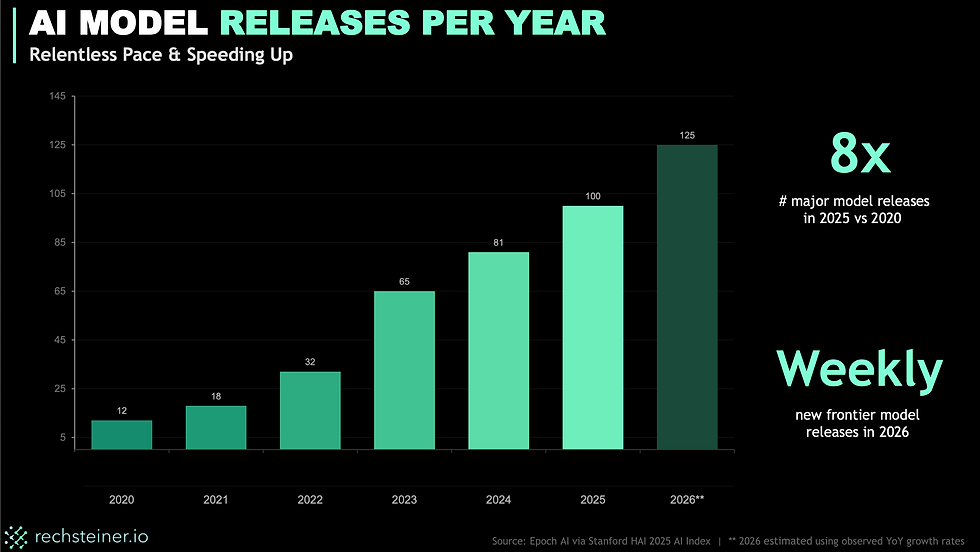
This isn't just a technology story. It's a business urgency story. Half of all global venture capital in 2025 went to AI. $202 billion invested in a single year, a 77% increase on the year prior. The platforms Australians are using to search and discover are shifting at the same pace. Gemini's weekly active users grew 425% year on year between March 2025 and March 2026. Perplexity’s users grew 333%. ChatGPT, still the dominant player at 800 million weekly active users, grew 78%. Claude more than tripled.

The implication for anyone in retail or brand marketing is that your customers are no longer just Googling. They are turning to AI, particularly in the comparison stage, and AI is answering without necessarily sending them to your website first.
The death of the click and why your traffic metrics are lying to you
One of the most confronting sessions at the NORA summit came from Partnerize, whose "Zero-Click World" presentation landed a statistic that should stop any digital marketer in their tracks: 65% of global Google searches now end without a click, rising to over 75% on mobile.
Nearly one in five Australians are now turning to AI for product inspiration. Higher income consumers are twice as likely to use AI daily. The risk of a 20–50% decline in traditional organic traffic is no longer a theoretical future scenario, it is beginning to play out.
Partnerize introduced the concept of "AI-debt" - the idea that the longer brands wait to optimise for AI discoverability, the deeper competitors' content becomes embedded in how LLMs respond to queries. Their data showed that brands adopting Answer Engine Optimisation (AEO) frameworks have seen up to 40% higher visibility in AI search results.
The closing message from that session was deliberately blunt: stop measuring clicks to determine effectiveness. By doing so you are likely to undervalue the investments being made in GEO and AEO and risk long term relevance.
Brands like Billini, the Australian footwear brand, offered a useful real-world example to highlight how they are adapting their strategy to drive visibility. Their strategy for LLM discoverability involves leaning heavily into online PR and media coverage alongside of investing in mid funnel content to surface their brand on third-party platforms, recognising that LLMs read from Reddit, editorial sites, listicles and review platforms. The implication for brands of all sizes is clear: your brand's presence outside your own website is now just as important as what's on it.
The PDP is still king but the rules have changed
One of the sharpest insights from Salsify's Decanting the Digital Shelf event was deceptively simple: the Product Detail Page has always been king, and it always will be – and it matters for both retailers and brands alike. But what a PDP needs to contain has fundamentally changed because of AI.
PDPs are becoming microsites in their own right. The expectation of rich content below the fold - think use case information, compatibility data, FAQs, how-to guides - has moved from nice-to-have to table stakes. And critically, this content is now being written for two distinct audiences simultaneously: the human shopper, and the AI agent that may be researching on their behalf.
This is a genuinely new creative and strategic challenge. For the shopper, you need narrative, emotion and confidence-building. For the agent, you need structure, specificity and completeness. The brands and retailers that will win in an agentic commerce world are those that treat product content as a living asset - one that is continuously enriched, not a one-time upload and forget.
The product data revolution
For the last decade, customer data was the strategic crown jewel. CRM, loyalty programs, behavioural analytics - these were where investment flowed and where executive attention was focused. Product data, by comparison, was the poor cousin: inconsistent, siloed, and often owned by nobody in particular.
AI is turning this completely on its head.
The point made at Decanting the Digital Shelf was clear: product data is now just as strategically important as customer data. An AI model responding to a shopper's query about the best reef-safe sunscreen for sensitive skin will only recommend your product if your data answers that question. The richness, accuracy and structure of your product content determines whether you appear in the answer, or whether your competitor does.
Despite its importance, product data still faces major organisational challenges. In many retail and brand businesses, no single team truly owns it. Responsibility is often fragmented across eCommerce, marketing, supply chain and category, with no clear leader accountable for quality. That has to change.
The challenge is also cultural. In the pre-digital era, a product could be ranged without much thought given to content. It was not seen as critical. Today, that is no longer the case. In a digital world, content is how a product is understood, evaluated and sold. It is the digital expression of the product itself.
And the need to fix this is becoming more urgent. The idea that AI will solve poor product data is a myth. AI does not replace weak foundations. It amplifies them. If the inputs are poor, the outputs will be too.
The use cases are proven, the question is execution
A highlight of the NORA summit was the comprehensive mapping of retail AI use cases currently in play globally. These ranged across twelve distinct areas – some of which included agentic shopping assistants, AI discoverability through AEO and GEO, generative content engines, customer service automation, computer vision for loss prevention and merchandising, loyalty programs, product ideation and concept development, and dynamic pricing.
Walmart, held up as a global retail market leader in AI implementation, illustrated what genuine enterprise-level commitment looks like. Their proprietary Wallaby LLM, trained on decades of Walmart-specific retail data, is designed to replace reliance on generic frontier models. Their AI supplier negotiation tool handles mid-tier supplier contracts autonomously with a 68% close rate and an average 1.5% margin benefit. Their Gemini-based associate tool fields three million queries a day across and 1.5 million frontline workers are using it, to deliver better customer service in the moment.
The key insight from Walmart's approach is that the competitive moat isn't the AI model. It's the proprietary data behind it.
Best practice is emerging and it starts with leadership
Perhaps the most practically useful framework from the NORA summit was Patrick Rechsteiner's three-pillar model for retail AI implementation success: People & Culture, Strategic Execution, and Go-to-Market.

On people and culture, the message was clear. AI literacy is non-negotiable, and it has to run from the board to the shop floor. There is no substitute for time on the tools. Leaders who delegate AI to the IT department and assume results will follow are making a categorical error. This is a business transformation, not a technology project.
On strategic execution, the principle of "strategy first, AI second" was central. The question is not "what’s my AI strategy?" it's "what problem am I trying to solve that AI can support?" The organisations winning in enterprise AI aren’t those making the biggest bets on AI blindly; they're those finding incremental gains through focused, well-scoped use cases. Domain expertise - the knowledge held by buyers, merchandisers, innovation teams, a store manager - is the differentiator that no technology vendor can replicate.
On go-to-market, the urgency is clear. Organic click-through rates on search engine results pages have collapsed from 1.76% to 0.61% in just 15 months. If your SEO strategy was designed for the world as it existed three years ago, it was built for a world that no longer exists. AEO and GEO are not future considerations; they are present-day requirements.
What to do with all of this
The consensus from both events, synthesised into the most actionable terms possible:
Your content and data foundations are non-negotiable. No AI strategy works without them. Invest in product data with the same urgency you bring to customer data.
Move now, not when you're ready. First mover advantage in AI discoverability is real. As search shifts from a long list of results to a short list of AI-curated recommendations, the brands already embedded in those answers will be very hard to displace.
Measure what actually matters. If you're still reporting on organic traffic and click volume as your primary indicators of digital health, you are flying blind in 2026. Build new metrics that capture AI-era influence.
Leadership sets the pace. Growth mindset - seeing the pace of AI change as an opportunity rather than a threat - is not a soft concept. It is the defining variable in which organisations will adapt and which will be left behind.
The AI conversation in Australian retail has arrived at an inflection point. The question is no longer whether to engage. It's whether your organisation is moving fast enough to keep up.
Arktic Fox partners with consumer brands and retailers to help them navigate and leverage a changing landscape. From content and data foundations through to AI discoverability, we focus on what actually drives visibility and performance. Let’s chat.